



Have you ever wondered how some online marketers make money from sales they weren't even involved in? Behind this lies a little-known dark industry – Cookie Stuffing. This fraudulent practice not only harms legitimate marketers but also jeopardizes the very foundation of trust in the affiliate marketing system.
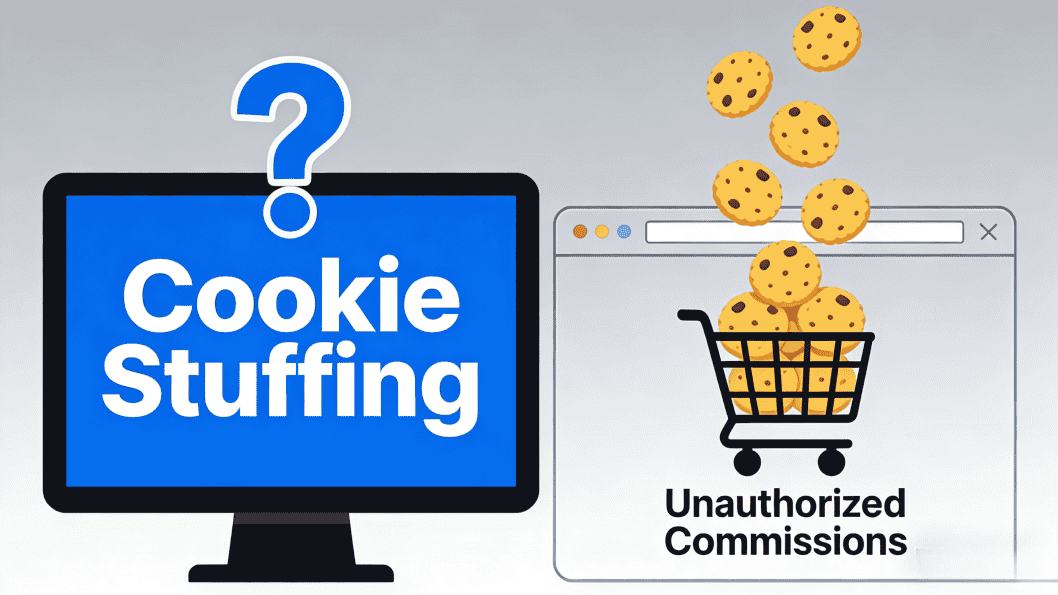
Cookie Stuffing is a deceptive online marketing tactic where fraudsters implant third-party tracking cookies into your browser without your knowledge. These cookies act like invisible "ledgers," recording your browsing behavior. When you subsequently make a purchase at an online store, the fraudsters can use these cookies to claim sales that don't belong to them, thereby defrauding affiliate commissions.
Imagine this scenario: You simply click on a webpage, do nothing else, and your browser is quietly filled with a dozen tracking cookies. A few days later, when you shop on Amazon or Facebook, the system mistakenly attributes the transaction to a "marketer" who never actually helped you. This is the reality of Cookie Stuffing.
The mechanism behind this fraudulent practice is quite straightforward, yet remarkably stealthy:
The most insidious aspect of this mechanism is that users are often completely unaware they are part of a fraudulent chain. You think you're just browsing the web normally, but in reality, you're paving the way for someone else's unearned gains.
To achieve their objetivos, fraudsters have developed various stealthy methods:
The common characteristic of these methods is their extreme stealth, making them very difficult for ordinary users to detect.
You might unknowingly become a victim in the following situations:
If you frequently log into e-commerce accounts on different devices or switch between shopping platforms often, you should be particularly wary of these fraudulent tactics.
The most direct victims of Cookie Stuffing are honest affiliate marketers. They may spend considerable time creating content, building trust, and recommending products, only to lose their deserved commissions due to cookies implanted by fraudsters. This not only results in direct financial losses but also dampens enthusiasm across the entire industry.
For merchants, Cookie Stuffing severely distorts marketing data. When you see a "conversion rate" appearing unusually high from a particular channel, it might not be due to the channel's quality but rather to Cookie fraud. This leads to marketing budgets being wasted on ineffective channels, while truly valuable partners do not receive the support they deserve.
From a user's perspective, Cookie Stuffing is a serious violation of personal privacy. Your browsing habits and shopping preferences are tracked and utilized without authorization. This data can be used to build your consumer profile or even sold to third parties.
For search engines and e-commerce platforms, Cookie Stuffing pollutes user behavior databases. When systems rely on inaccurate data for analysis, the accuracy of search results and the quality of personalized recommendations decline. You might find products you haven't searched for repeatedly appearing in your recommendations, which could be a sign of Cookie fraud.
The EU's ePrivacy Directive explicitly states that before storing any cookies in a user's browser, websites must obtain explicit user consent. This means those pop-up "Cookie consent" banners are not decorative but a legal requirement.
Cookie Stuffing directly violates this principle by completely bypassing the user consent step. Engaging in such activities within the EU can lead not only to hefty fines but also to criminal liability. Even outside the EU, with growing privacy awareness, similar regulatory measures are being gradually implemented.
Online platforms and search engines cannot simply be "onlookers." They have a responsibility to implement security measures to prevent Cookie fraud:
Transparency is key. When users can clearly understand which cookies are tracking them and how that data is being used, they can make truly informed choices.
As an ordinary user, you can take the following steps to protect yourself:
A practical tip: Before making a significant purchase, use your browser's incognito mode or switch to a separate browser profile dedicated to shopping to ensure you are not affected by potential tracking cookies from your previous browsing history.
If you are an affiliate marketer or a merchant, the following practices can help reduce your risk:
In today's digital world, understanding how cookies work has become a fundamental aspect of digital literacy. Cookies themselves are not inherently malicious; they allow websites to remember your login status, shopping cart contents, and preferences, greatly enhancing user experience. The problem arises when this technology is misused, leading to privacy and security risks.
When you are aware that every click on a link can leave a tracking trace, you become more cautious about the websites you visit and the links you click. This awareness isn't about making you overly anxious but rather about helping you make smarter online behavioral choices. For example, when comparing prices for online shopping, you might prefer to directly visit the official website rather than clicking on "discount links" from unverified sources.
For cross-border e-commerce practitioners, affiliate marketers, or users who need to manage multiple online identities, professional browser environment management tools have become essential. Traditional methods involve switching between different browsers or using multiple devices, which is not only inefficient but also still carries the risk of cookie leakage.
Fingerprint browser technology offers a more elegant solution. Taking MasLogin as an example, it can create completely independent browsing environments for each online identity, each with its own distinct cookies, cache, and browser fingerprint. This means you can run multiple fully isolated browsing sessions on the same computer simultaneously, with accounts not interfering with each other and unaffected by cross-contamination from fraudulent practices like Cookie Stuffing.
This isolation not only prevents Cookie fraud but also enhances account security. If one of your accounts encounters a security issue, others will not be affected. For professionals who need to manage multiple e-commerce stores, social media accounts, or affiliate marketing accounts simultaneously, this isolation mechanism significantly reduces operational risks.
The existence of Cookie Stuffing serves as a reminder that the digital marketing industry still requires stricter self-regulation and oversight. This is not just a technical issue but a matter of trust. When fraudulent activities are rampant, it's not just individual merchants or marketers who suffer, but the credibility of the entire industry.
Solving this problem requires a collective effort from three parties: users need to enhance their digital literacy and learn to protect their online privacy; platforms and search engines must take on regulatory responsibilities by establishing more effective anti-fraud mechanisms; and marketers must uphold professional ethics, refusing to participate in any form of fraudulent behavior.
From the perspective of technological development trends, cookies are gradually fading into history. Google has announced the phasing out of third-party cookies in its Chrome browser, and other browser manufacturers are following suit. Future tracking technologies will focus more on privacy protection, such as differential privacy and federated learning, which will eliminate the breeding ground for fraudulent practices like Cookie Stuffing.
However, until new technologies are fully adopted, understanding the principles of Cookie Stuffing and how to prevent it remains crucial. Only when every internet user possesses basic privacy protection awareness can they enjoy the convenience of the digital world while safeguarding their online security. Remember, the next time you click a link, think for a moment: Do I really need this cookie?
The most direct method is to check your browser's cookie list. In Chrome, you can go to "Settings > Privacy and security > Cookies and other site data > See all cookies and site data" to see if there are many cookies from unfamiliar domains. If you find cookies from certain affiliate marketing sites, but you are sure you have never visited those sites, it's highly likely they have been implanted. Additionally, if you find unexpected products suddenly appearing in your shopping cart, or if you receive marketing emails from unfamiliar merchants, you should also be wary of Cookie fraud.
Legitimate affiliate marketing is based on genuine user actions: you see a marketer's recommendation, actively click on their provided link, and then make a purchase. The marketer earning a commission in this scenario is reasonable. Cookie Stuffing bypasses this process; users have no genuine click action, yet cookies are forcibly implanted. Simply put, legitimate affiliate marketing is "I helped you find a good product," while Cookie Stuffing is "I secretly left a mark in your browser to pretend I helped you."
Privacy mode (incognito mode) does reduce the risk to some extent because all cookies are cleared when the browser is closed. However, it cannot completely prevent Cookie Stuffing. If you visit a webpage containing malicious scripts in privacy mode, the cookies will still be effective during that session. More importantly, privacy mode cannot stop browser extensions from implanting cookies, and malicious extensions are a common carrier of Cookie Stuffing. Therefore, privacy mode is only basic protection; other measures like regularly clearing extensions and using professional browser tools are also necessary.
Merchants can look for several abnormal indicators: is the conversion time distribution unusual (e.g., many conversions occur in the final hours after cookie implantation)? Is the user behavior path too simple (direct purchase without normal browsing or comparison)? Is the conversion rate from a particular affiliate channel abnormally high, but the actual user quality is very low? Additionally, third-party anti-fraud tools can be used, or "last-click attribution" rules can be included in affiliate agreements, crediting commission only to the source of the user's last genuine click before purchase.
As browser manufacturers gradually phase out third-party cookies, the space for Cookie Stuffing will significantly shrink. New technologies like Google's Privacy Sandbox are exploring ways to enable effective tracking while protecting privacy. These technologies are based on aggregated data rather than individual identifiers, rendering traditional Cookie fraud tactics ineffective. However, fraudsters are constantly evolving and may shift to other tracking techniques like device fingerprint fraud. Therefore, technological upgrades are only part of the solution; establishing robust regulatory mechanisms and enhancing universal digital literacy are even more important.
Outline




 (1) (1).png)