

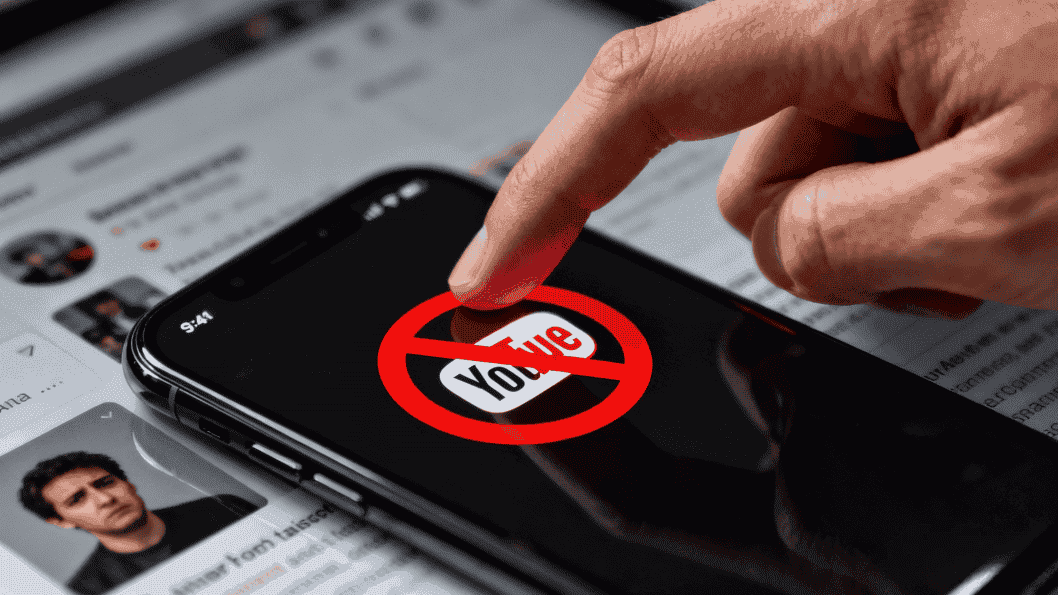
When you open YouTube at a company, school, or on public Wi‑Fi, you may suddenly see a message like:
“Restricted Mode has been enabled by your network administrator.”
This simply means: “Restricted Mode has been enabled by your network administrator.”
Behind this line, your network has actually put a “filter layer” on top of your connection.
In simple terms:
The impact on regular users is very direct:
Below we’ll fix this “Restricted Mode has been enabled by your network administrator” issue step by step, ordered by difficulty and general applicability: VPN → Mobile DNS → Browser DNS.
On many public networks, Restricted Mode is enforced using a combination of network egress + DNS. As long as your traffic exits through that path, Restricted Mode is forced on.
The idea behind a VPN is: instead of accessing YouTube directly from your current network, you first connect to a relay server, and then that server helps you access YouTube.
• Speed and protocol:
Watching video requires high bandwidth. Choose services that support high‑speed protocols like WireGuard or OpenVPN UDP and aim for low latency.
• Server locations:
Generally recommended:
• Privacy and security:
Avoid suspicious “completely free, unlimited” services. Many make money by logging and selling your traffic data.
• Catching up on technical tutorials at work without being blocked by corporate DNS policies
• Accessing educational content misclassified as “sensitive” at school (some IT/medical/art videos get wrongly filtered)
• Running YouTube marketing abroad: switch to target‑market IPs to see real recommendations and search results
If you only want to watch videos freely, a VPN alone is usually enough.
But if you’re involved in multi‑account operations / cross‑border marketing / ad campaigns, a VPN by itself is far from sufficient.
In that case, you can combine a fingerprint browser like MasLogin:
For teams doing YouTube promotion, channel matrices, or cross‑border ad campaigns, this setup is much safer and more controllable than just using one system‑wide VPN.
If you don’t have a VPN or don’t want to bother with it for now, start with the basics: DNS settings.
In the original subtitled video, the second method fixes Restricted Mode by using Private DNS on Android.
Using stock Android as an example; most brands have a similar path:
Essentially, this tells your phone: “Stop using the DNS rules pushed by this Wi‑Fi network.”
• Users without a VPN or who can’t conveniently install one
• People frequently on school/public Wi‑Fi and suspect DNS tampering
• Users who mainly watch YouTube via mobile apps and rarely on desktop
• After disabling Private DNS, some security filters and malicious‑site blocklists may stop working
• If you’re on a company/school network with strict usage policies, changing DNS may violate internal IT rules
• If compliance is a concern, test first using your own 4G/5G hotspot before changing DNS on corporate/school Wi‑Fi
On desktop, most people watch YouTube through a browser. In this scenario, you can enable Secure DNS directly in your browser and manually switch to Google Public DNS.
The third part of the original subtitled video demonstrates this solution.
When you enable Secure DNS in your browser and select Google Public DNS, you’re essentially telling the browser:
“When accessing YouTube, ask Google directly for DNS results, and ignore the DNS rules provided by my company/school network.”
If the “Restricted Mode has been enabled by your network administrator” message disappears, your browser is no longer following the network administrator’s DNS policies.
• Videos that were previously hidden or blocked now appear and play normally
• Some pages that used to load slowly become smoother (no more ISP‑inserted content)
• Sites that used to be mysteriously redirected start behaving normally again
• Users who mainly watch YouTube on a PC browser
• People temporarily using company/library PCs who can’t freely install VPN software
• Cross‑border teams who need a cleaner browsing environment with less ISP interference
If VPNs, Private DNS changes on mobile, and Secure DNS in the browser all fail, the problem is likely no longer in your local settings, but at a higher level.
• Restricted Mode set at the Google account level
• Enforced policies by an organization administrator
• Filtering at the router or ISP level
Try this order:
These steps help you determine whether the issue lies with the account, the device, the network, or a higher‑level control.
• Prepare a “clean” environment for study/work, such as always using a mobile hotspot plus a dedicated browser profile
• Avoid mixing personal entertainment accounts and work accounts in the same native browser — this can confuse algorithms and trigger risk controls
• If you’re in cross‑border business or social media operations, create dedicated work environments in MasLogin, where DNS/proxy/fingerprints are all fixed per profile and not constantly affected by local network changes
![4A_)]2P@B1)_HMW(]EI2]XY.png](https://masmate.service-online.cn/production/files/0/1764662017661754712_16555.png)
For regular users, the story ends once Restricted Mode is off.
But for many cross‑border professionals, content creators, and ad buyers, the real issues go far beyond “can I watch this video”:
In this context, disabling Restricted Mode is only the first step. The more critical goal is to build a segmented and secure browsing environment.
A fingerprint browser like MasLogin essentially “virtualizes multiple different devices” on one machine:
You can learn more about terms like “fingerprint” and “profile” in the MasLogin glossary; this helps a lot in understanding the whole mechanism.
• Create a separate browser profile for each YouTube account:
• Pair each profile with a different country/region proxy or VPN:
• One‑click management and batch operations:
For YouTube channel matrices, cross‑border e‑commerce, independent sites, and overseas social agencies, this approach is far more stable, secure, and efficient than manually switching browsers and clearing caches all over the place.
You can also browse the MasLogin blog for more real‑world cross‑border use cases, including how to reduce platform risk controls and optimize account warm‑up processes.
First try your phone’s 4G/5G hotspot or another home Wi‑Fi.
If it works on the new network, the original network is the problem. Your school/company or router may have higher‑level restrictions that local DNS changes can’t bypass — in this case, consider using a VPN.
Your phone may be using mobile data or different DNS/Private DNS settings, while your computer is using the router‑assigned DNS directly.
Try enabling Secure DNS in the desktop browser and switching to Google Public DNS, then test again.
As long as your behavior is normal and you’re not doing fake traffic or cheating, VPN/DNS changes alone usually don’t directly cause bans.
However, frequently switching countries and having multiple accounts share the same environment can trigger risk controls. For multi‑account operations, it’s better to use a fingerprint browser like MasLogin to give each account its own environment and lower linking risk.
Restricted Mode can be enforced at both the account and network levels.
Even if your account settings show it as off, network admins can still force it at the network egress or DNS level. In this case, you need to tackle it from the network side using the three methods in this article.
Avoid constantly signing out/in with different accounts in the same native browser.
A more reliable method is to use MasLogin and create a separate browser profile for each account, fixing its IP, fingerprint, and cookies so the platform sees them as “different devices”, while also leveraging VPN/DNS settings per profile to handle Restricted Mode and cross‑region access.
Outline