


When you open the news and see yet another Facebook data breach, have you ever thought: maybe it’s time to switch platforms? The latest incident affected more than 500 million users. This isn’t an accident; it’s the culmination of years of Facebook privacy problems. More and more people are asking: do we really need to hand our entire social life over to one single platform?
Facebook was once a bridge that connected the world; now it has become a “data prison” many people want to escape. The problem isn’t just the occasional technical glitch, but a systemic crisis of trust.
Privacy breaches have become the norm rather than the exception. From the Cambridge Analytica scandal to recent large‑scale leaks, users’ personal information has been exposed again and again. Even more worrying, this data is often used for hyper‑targeted advertising and even political manipulation. You think you’re using the platform for free, but in reality, you’re “paying” with your privacy.
Content moderation controversies continue to intensify. Algorithms decide what you can and can’t see; filter bubbles trap everyone in their own echo chambers. Timelines are no longer chronological, but algorithmically manipulated to prioritize the content that keeps you scrolling longer and clicking more ads.
Users are waking up to the fact that we need more transparent data‑use policies, fewer ad intrusions, and more authentic social experiences. That’s why a wave of Facebook alternatives has emerged, each trying in its own way to redefine what a social network can be.
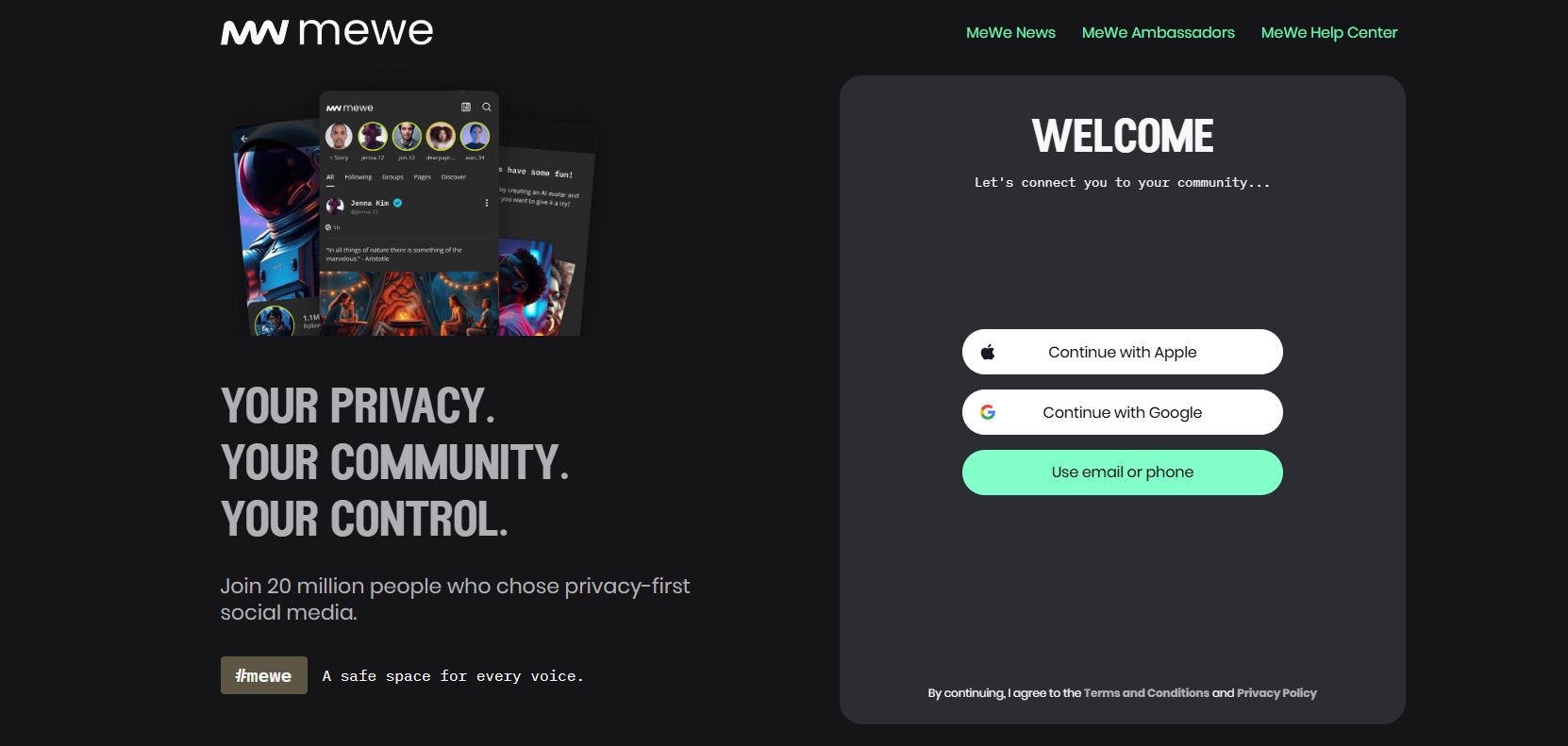
If you’re looking for something that feels the most like Facebook, MeWe might be your best option. Its tagline is “Your private life is #NotForSale”, and that’s not just a slogan.
MeWe offers nearly all of Facebook’s core features: news feed posts, photo albums, group discussions, private messaging—minus the parts people hate most: no ads, no data tracking, no algorithm manipulating your timeline. Your posts appear in simple chronological order, much like the early days of Facebook.
It’s also worth noting that MeWe’s advisory board includes Tim Berners‑Lee, the inventor of the World Wide Web. He has long advocated for an open, decentralized web, and his involvement lends credibility to MeWe’s privacy promises. The platform has a web version plus iOS and Android apps, and the overall experience is smooth.
![H12EF[78D5]_C@(5]BAGF_2.png](https://masmate.service-online.cn/production/files/0/1764729128347019853_30723.png)
Vero is more of an Instagram replacement than a Facebook clone. It focuses on sharing photos and links, with a clean, elegant interface and no ads or algorithmic interference.
Its standout feature is fine‑grained privacy control. Every time you post, you can choose to share with “Close Friends”, “Friends”, “Followers”, or “Public”. This tiered system lets you precisely control who sees what, and it’s far more intuitive than Facebook’s often confusing privacy settings.
Vero is mobile‑only (iOS and Android) with no web client. Recent updates added voice and video calling, evolving it from a pure content‑sharing space into a more complete social tool.
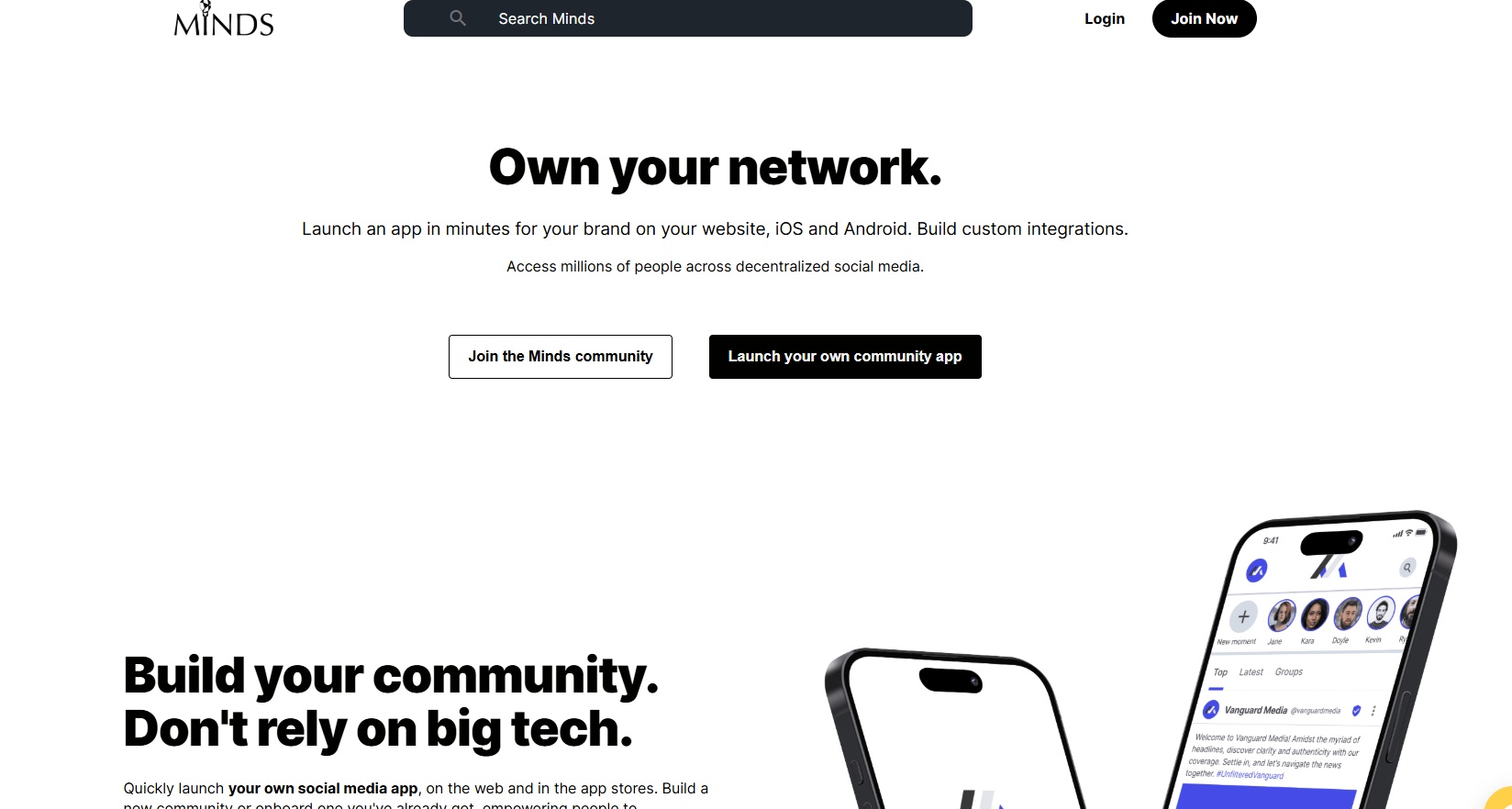
Minds calls itself an “anti‑Facebook crypto social network”, which is quite an aggressive positioning. It’s open‑source, promising greater transparency, less censorship, and a more diverse environment for discussion.
Its most unique aspect is the creator rewards model. If your content performs well, you can earn directly in USD, Bitcoin, or Ethereum. This breaks away from the traditional “platform profits, creators contribute for free” model.
Minds is free to use, but also offers Minds Plus, starting at $5 per month, unlocking additional features. It’s available via web and mobile apps, and suits users who care about free expression and monetizing their content.
Mastodon and Diaspora both use decentralized architectures, but their styles are very different.
Mastodon is more like a Twitter alternative, with 500‑character posts but no real content‑type limits. There’s no official, single app or website; instead, you choose or create an “instance” to join. Each instance is run by its own community and has its own rules and culture. This design makes it nearly impossible for any single company to control or censor the entire network.
Diaspora offers an experience closer to Facebook’s, using a “pod” system. You can sign up on an existing pod or host your own. In general, Diaspora is better for people who want a fuller social‑network feature set, while Mastodon tends to attract those who prioritize free speech.
Today, Mastodon’s user base is roughly four times that of Diaspora, and its community is more active. But if you mostly want the core Facebook‑style features, Diaspora may be easier to get into.
![]J22J$_GR8}M{PG7[C`DNWF.png](https://masmate.service-online.cn/production/files/0/1764729139739338649_24848.png)
LinkedIn, owned by Microsoft, is essentially irreplaceable in the professional networking space. It’s not just an online résumé—it's where you build your professional network, discover job opportunities, and learn about your industry.
Plenty of people really do find their ideal jobs through LinkedIn. Its recruiting tools, industry discussions, and professional content far surpass other social platforms. It has had data‑breach incidents as well, but as a career tool, its value is still very high.
Reddit is a massive discussion aggregator where users join various “subreddits” to talk about almost any topic imaginable. Content is ranked by upvotes and downvotes, so high‑quality discussions rise to the top.
If you mainly use Facebook for groups and discussion, Reddit will likely serve you better. Do note, however, that its moderation policies can be controversial, and some sensitive topics may face restrictions.
No single platform can perfectly replicate everything Facebook does. The key is finding a combination that fits your core needs.
If your top concern is privacy, MeWe, Vero, and Minds are strong options; they explicitly promise not to sell user data. If you want full decentralization, Mastodon and Diaspora offer the greatest freedom, but come with steeper learning curves.
For career development, LinkedIn is almost mandatory. If you enjoy in‑depth discussion, Reddit generally has higher‑quality communities. Visual creators may prefer Vero or Ello.
A sensible approach is to use multiple platforms in parallel. You don’t have to abandon Facebook overnight. Start by creating accounts on new platforms, and gradually migrate your content and social graph. Back up important data, export your contacts if possible, and leave your new handles where friends can find them.
It takes time to adjust. Each platform has its own culture and norms. With some experimentation and observation, you’ll discover the digital lifestyle that feels most comfortable.
Once you start running accounts on several platforms, a new problem appears: how do you manage them safely and efficiently?
The traditional way is to log in and out repeatedly, or use your browser’s multi‑account or profile features. But this creates privacy risks—platforms can correlate your accounts via browser fingerprints, IP address, and other signals, potentially leading to bans or privacy issues.
That’s why many people turn to fingerprint browser tools. Take MasLogin as an example: it can create an isolated browser environment for each account, preventing platforms from linking them via technical means. This is useful for social media marketers, content creators, or anyone who simply wants to keep work and personal accounts strictly separate.
Key features include account isolation, data encryption, and team collaboration tools—so you can enjoy the benefits of multi‑platform use without sacrificing privacy and security.
Facebook’s troubles are not a fluke; they are the logical outcome of the centralized social‑platform model. When one company controls the data of billions of people, its commercial interests will inevitably clash with user privacy.
The rise of decentralized social networks points to another path: users own their data, communities govern themselves, and platforms are no longer the sole centers of power. This is not a utopian fantasy—Mastodon and Diaspora have already demonstrated that it can work.
Privacy protection is becoming a core competitive edge. Can ad‑free models be sustainable? Are users willing to pay for privacy? Can the creator economy change the content landscape? The answers to these questions will shape the next decade of social media.
Most importantly, you don’t have to put all your eggs in one basket. Try different platforms, assemble the mix that suits you best, and adjust as your needs evolve. Social networks should be tools, not shackles. When you take back your freedom to choose, your digital life truly becomes your own.
Relatively speaking, yes. Platforms like MeWe and Vero explicitly promise not to sell user data or run targeted ads, which reduces privacy risk at the business‑model level. Decentralized platforms such as Mastodon and Diaspora go further by storing data on distributed servers, making it impossible for a single company to fully control everything. But nothing is absolutely secure. Any platform may have technical vulnerabilities—the key is choosing services that are transparent and have strong privacy commitments.
It depends on your social circle. Established platforms like LinkedIn have a massive user base, so you’re more likely to find people you know. Newer platforms like MeWe or Minds have fewer users but are growing quickly. A practical approach is the “bridge strategy”: post on Facebook letting people know your new accounts, or contact friends through email, WhatsApp, etc. Migrate gradually instead of cutting things off overnight, and give your network time to adapt.
There is a learning curve. Mastodon requires you to choose an “instance”, and Diaspora asks you to pick a “pod”—which can feel unfamiliar if you’re used to centralized platforms. But in practice, it’s not that hard; it’s similar to choosing an email provider (Gmail vs. Outlook). Once you’re set up, daily use is straightforward. Many instances offer beginner guides, and communities are generally welcoming. If you want something simpler to start with, MeWe or Vero might be easier.
That depends on what you need. If you just want to share life updates and interact with friends, most alternatives can handle that. But if you rely on Facebook for events, marketplace features, games, and more, you may need a combination of tools. There is no perfect one‑to‑one replacement. The key is assembling a set of platforms that cover your core needs. Many people keep a Facebook account for certain functions while moving their main social activity elsewhere.
Facebook does offer data export tools, letting you download your photos, posts, contacts, and so on. But you usually can’t just import all that into another platform, because of format and feature differences. In reality, migration is more like a “fresh start”: back up what matters, repost selectively on the new platform, and gradually rebuild your network. It takes time, but it’s also a good opportunity to declutter your digital life—shed the noise, and keep the connections that actually matter.
Outline


 (1) (1).png)